

Fresh Air and Comfort Through Every Canadian Season
Why do Canadian homes need HRV and ERV systems?
Canada experiences some of the most demanding seasonal conditions for residential ventilation. From freezing winter temperatures to hot, humid summers, maintaining comfortable and healthy indoor air requires more than heating and cooling alone.
Modern homes need a reliable supply of fresh outdoor air while minimizing unnecessary energy loss. Heat Recovery Ventilators (HRVs) and Energy Recovery Ventilators (ERVs) help achieve this balance by providing controlled ventilation and recovering energy from the air leaving the building.
Built for Cold Canadian Winters
During winter, indoor heating systems work hard to maintain comfortable temperatures. Opening windows to bring in fresh air can result in significant heat loss, cold drafts, and increased heating costs.
An HRV or ERV continuously replaces stale indoor air with fresh outdoor air while transferring heat from the outgoing air to the incoming air. This reduces the energy needed to warm the fresh air compared with ventilation without heat recovery.
In extremely cold conditions, proper equipment selection, frost protection, defrost operation, and installation are important for reliable performance.
Managing Summer Heat and Humidity
Canadian summers can also bring high temperatures and outdoor humidity.
An ERV can transfer both sensible heat and some moisture between incoming and outgoing air streams. Under suitable conditions, this can help reduce the additional cooling and dehumidification load caused by ventilation.
An HRV transfers primarily sensible heat and can also support summer ventilation, although it does not provide the same moisture-transfer function as an ERV.
Why is heat recovery especially valuable in Canada?
Consider a simplified winter example.
Temperature difference: 42°C
Every cubic foot of cold outdoor air introduced into the home must be heated to maintain indoor comfort.
Without heat recovery, the heating system must compensate for most of that ventilation heat loss.
With an HRV, heat from the outgoing indoor air is transferred to the incoming outdoor air, reducing the ventilation heating load.
For illustration, at 100 CFM and a 42°C temperature difference, the sensible ventilation load without heat recovery is approximately:
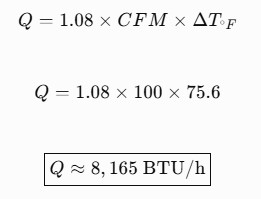
That is approximately 2.39 kW of continuous heating load at those conditions.
A heat-recovery system can reduce a substantial portion of that load. The actual savings depend on airflow, recovery efficiency, operating conditions, defrost cycles and fan energy.
Helping Protect Canadian Homes
Cold outdoor temperatures can cause condensation on windows and other cold surfaces when indoor humidity is excessive.
Proper ventilation helps remove moisture generated by everyday activities such as cooking, showering, laundry, and occupancy. By helping control indoor moisture, HRV/ERV systems can reduce condensation risk and support the long-term protection of building materials.
However, ventilation must be properly designed and balanced, and it does not replace the need to address water leaks or other moisture sources.
Why It Matters
- Fresh-air ventilation during cold winters and warm summers.
- Reduced ventilation-related heating and cooling energy losses.
- Better management of indoor humidity and condensation.
- Improved indoor comfort and air quality.
- Ventilation solutions suitable for modern Canadian construction.
FLOWFLEXI helps homeowners and HVAC professionals select HRV and ERV solutions appropriate for Canadian climate conditions and building requirements.