
HRV vs. ERV
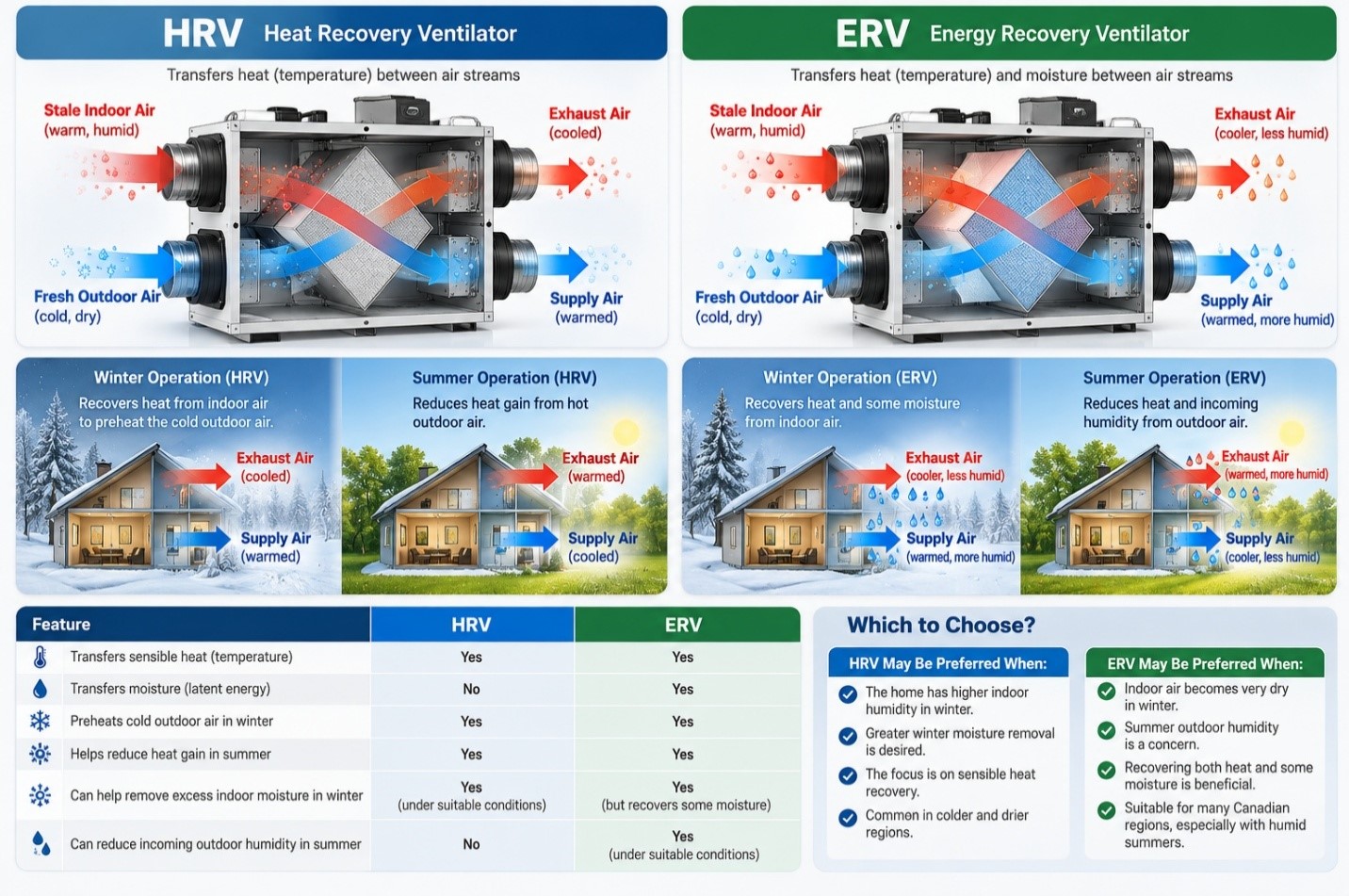
Both HRVs and ERVs bring in outdoor air, exhaust indoor air and recover energy. Their key distinction is moisture transfer: an HRV primarily recovers sensible heat, while an ERV recovers heat and some latent energy associated with moisture.
Feature | HRV | ERV |
Outdoor-air supply and exhaust | Yes | Yes |
Sensible heat recovery | Yes | Yes |
Moisture transfer through core | Generally no | Yes, to some extent |
May help reduce excessive winter indoor moisture | Yes, where outdoor air is drier | Yes, but moisture recovery can reduce drying |
May moderate incoming summer humidity | Not through heat-exchange core | Yes, under suitable conditions |
How to Choose
An HRV may suit a home where wintertime moisture removal is a priority. An ERV may be useful where summer humidity or excessive winter dryness is a concern. Neither technology is universally better for Canadian homes. Selection must consider local climate, occupants, moisture loads, building airtightness, airflow, static pressure, frost protection and specific equipment.